Showing posts with label Travelogue. Show all posts

July 28, 2011

Spain Vignettes: Comida es la vida

“Tengo Hambre” was one of the first Spanish phrases that I learnt, and more importantly, never forgot, because of how important it is – “I am so hungry”. When I asked Ash about planning a trip to Spain, Ash, who has been to Spain twice, wrote me a detailed reply. At the end of the email, he said simply, scratch all I said, just go for the food.

We were ready to be gastronomically delighted. And we were. Right from our first meal in Madrid. By the time we got out at Anton Martin station, we were hungry. As we walked down the street we saw a restaurant sign, we didn’t need much more invitation than that. I had read somewhere that the a-OK gesture (circle with index finger and thumb, other three straight out) was an offensive gesture in Spain, so we tried our best to use our middle three fingers while saying ‘tres’ while asking for a table or asking for coffee.

One of the dishes was pollo, the other was tortilla with patatas y jamon. We may have ordered a third, I don’t remember now. I noticed that Attu was eating quite slowly. And because Neeto and I were wolfing down food, I was quite concerned Attu wouldn’t have anything to eat at her pace. So I broke off bits of the chicken leg and tried to make sure she was eating. That courtesy lasted that one meal, probably because I hadn’t seen her in years. By the end of the trip I was wolfing down her food before she got to it.

Anyway, this is a food post, so I will keep it short and picture-friendly. I may not remember the names of most of the dishes, so feel free to help me out.

Our first dinner in Madrid, somewhere near Puerta del Sol.


This was the restaurant. Well, as you can see above, we had to have a second dinner a few hours later, of which we don't have any pictures of. Of note, at the second dinner we were introduced to croquettas and aceitunas. We probably tried to have them at nearly every meal after that. YUM!


We only had coffee here...but look at the display!


Lunch, near Plaza de Oriente, next to Palacio Real de Madrid. As Toni informs us in the comments below, this dish is called Pulpo a la Gallega.


Dinner at Mercado de San Miguel. Highly recommended. You will see a lot more locals than tourists too. They were really friendly and offered to take our pictures when they saw us take out our cameras. One of the skewers was 'chicken tikka', delicious.


Caviar!!!


Tres Cafe Con Leche, Barcelona. I am not generally a coffee drinker, but loved the coffee in Spain! Given our packed schedule and how little sleep we were getting, the cafe visits were a necessity. This particular cafe was run by an old man. It looked like a house converted to a cafe. Near the ceiling, you could see what looked like solid white window-doors, painted the same colour of the walls.


After a visit to La Sagrada Familia, we went to a cafe nearby. There were three sections, in the first we saw two old men playing chess. We walked to the second section, with painted red walls, a love-seat and two antique cushion chairs. There was a young woman running the show, and she spoke to us entirely in English. We realized people in Barcelona were more likely to speak in English and was the only city where we began speaking in English, instead of attempting Spanish.

Lunch at a restaurant by the sea in Barcelona. We were told at the hostel to head to this area to find the best food. This shellfish is called Navajas.


Two kinds of paella, the one on the left is made entirely of verduras.


And a closer look at one of the little guys in the paella on the right...


In Granada, we were hurrying from the walking tour to Alhambra so we could make it in time to the allotted hour on our tickets. We ate at a cafe-restaurant inside, there were only cold foods available. The gazpacho was quite memorable, but we were too hungry to think about taking pics. Also, our cameras had given out by then. Aric, our tour guide had recommended a place for dinner. Lamb kebabs,gambas al ajillo and calamari were on the menu.


I had read that churros con chocolate was not to be missed in Spain. Don Pepe in Cordoba is quite famous for its churros, at least according to the restaurant where we had our lunch. This restaurant still had a poster of the World cup winning team pasted on its wall, now somewhat faded, in just a year. I took a picture of it too. The churros:


The menu at a tapas place by the road.


In Sevilla, we had lunch with a few others from our hostel, and forgot to take pictures. Here we tried the menu del dia option. The sopa de arroz that was placed in front of Attu was delicious. We had dinner at the public casetas at Fiera de Abril, and we definitely had plenty of croquettas.

Full circle. Before we left to drop Attu at the Barajas airport in Madrid, we ate lunch at the same place by Anton Martin station where we had our first meal in Spain.


Chocolateria San Gines. Chocolate con churros. Enough said.


These are pics from my camera, I will update the post later with pics from the other two.

Update: Attu sent me these photos from her camera. Our meal in Cordoba, at a little cafe-restaurant where the waitress later recommended Don Pepe when we asked about a churros place.


The only food worries I had were beef-related, as I wanted to make sure I didn't consume any. So I tried learning the words that can be used for beef in Spanish. Thankfully there are a lot of the dishes in Spain with pescado and/or jamon, so this wasn't too much of a problem. It helped that I had tried learning basic words (arroz, pollo, et al) prior to the trip. A little research goes a long way!

Tengo hambre amigos?

**

Title: Well, I am deviating from my song-themed spain posts for this one.

July 13, 2011

Spain Vignettes: Locos por el fútbol: ¡HALA MADRID!


April 30 2011. Madrid.


I had been excited for the match ever since I booked the tickets, but grabbing the yellow Real Madrid tickets from the La Caixa ATM solidified the feeling: I was going to see Real Madrid play in their beautiful stadium.


All of us wore white. My journal came in handy to figure out the trains to take to Estadio Santiago Bernabeu. The crowd increased as we got closer to our destination, and there were a lot of people dressed in RMCF gear, and we spilled out of the metro station and spotted Real Madrid’s home immediately. I could have squealed for joy. I probably did. After pictures of Estadio Santiago Bernabeu, we headed to the stadium, as I wanted to catch a few minutes of the warm-up, but amidst the confusion about our seats, we missed most of that. Let that not detract from the incredible feeling you get on entering the seating area of the stadium. Our tickets, being the cheapest we could get our hands on, were located on the very top of this 80 thousand seater stadium. True to claim, you can tell this is one of the temples of football. Imagine how incredible it must be for a player to walk on to the pitch here! And how intimidating the opposing team would feel, as evidenced by the Spurs during the first quarterfinal leg of the CL.

The opponent was Real Zaragoza, on paper a dim-weight flirting with the relegation zone. We caught this La Liga match in between two Championship League semi final games. The ‘Hasta el final, Vamos Real’ banner was still there, and yet, we had just lost the first leg against Barcelona, at home. The warm up ended, and as ‘Hala Madrid’ came on the speaker system, a video showing goals and accomplishments of club greats played, while the Copa del Rey stood displayed. Then Casillas and Ramos took the cup in hand to show it to the fans, and surprisingly, Iker trusted Sergio to return the cup back to waiting safe hands in spite of what happened the last time he held it.

The first 45 minutes passed all too quickly, while I took photos and videos and squealed when I saw Mou giving instructions from near the bench. The game however, was not going to plan. Real Madrid should have decimated Zaragoza by now. But the team was without its regulars, and it showed. San Iker messed up, which wasn’t a good sign. Granero was replaced by Alonso in the second half, 2 goals were scored (including a header taken by Ramos), but it wasn’t enough. I watched in disbelief as the game ended 2-3.

There was a little boy next to us, and his family was trying to get him involved in supporting the team, teaching him chants. I asked his dad to teach me one, but I have forgotten it. I had to ask him via sign language, because I didn’t know the right Spanish words, and he didn’t know English. Every time Madrid lost possession or did something stupid, he would say “Hombre” in a very disappointed voice.

The camera pics don’t reflect it, but we could see the action on the field quite clearly. We were sitting between the goal and the benches. I could easily tell who was warming up, but then, Marcelo’s hairdo is probably visible even to a passing airplane.

Credit to Zaragoza for playing really well, but I was disappointed that the game I had come to watch ended in a loss.

**

May 03-04 2011. En route to Granada from Barcelona.

The day we left Madrid for Barcelona, Real Madrid also left for Barcelona to play the second leg of the Championship League semi-final tie. The next night, while they started the game at 8.45 PM, we were to catch the overnight train to Granada. I was not able to get hold of the score before we boarded, and wasn’t sure whom to ask after 10.45, by when the game would have ended. Finally, at 1 AM, I couldn’t take it anymore. We were in Valencia, a few people had just boarded our coach, and the ticket collector came by. I grabbed hold of his sleeve as he passed.

“Perdon.. ¿Barcelona-Real Madrid?” knowing I didn’t need to say anything else.

He held up his pointer fingers on both hands: “¡Uno - Uno!”

Everyone that was still awake in the coach burst out laughing, and some others up ahead asked him to confirm the score once more.

**

May 07 2011. Madrid.

The day we were enjoying the Feria de Abril in Sevilla (May 6th), Real Madrid traveled to Sevilla as well. However, they were to play the next day. While in the cab to drop Attu off at the Barajas airport the next day, the cabbie was listening to a game. I asked him if it was Real Madrid playing, he said they were playing at 10 PM. I tried to ask him which teams were playing at that instant, but I didn’t know how to say “who”, and the cabbie was not as chatty as our Sevilla one, so I didn’t get an answer. We bid Attu adieu, the week had passed by so quickly!

We were having a late dinner in Plaza Mayor, in the open. The only TV I could find was inside of a restaurant next to the one we were eating at. Most of its customers were seated outside too. About 30 mins into the first half, I ducked inside to check the score. A barkeep saw me look for the TV and told me the score. I checked the TV, and just as I did, Cristiano scored a goal. Pleased, I went back out.

My paella was muy mal, both in taste and appearance.

After dinner, I wanted to check the score, there was about half an hour left to be played. I went back into the restaurant. The barkeep spotted me come in, and immediately said “Cero-Tres”, smiling. Awesome!

I still hadn’t learnt how to say “who”. So I tried signing for it instead. Apparently the ‘Alapadma’(fingers spread out) mudra in Bharatnatyam is not a universal gesture for this question. So I tried listing “uno gol, Cristiano” I said, continuing, “dos gol, tres gol?”

The barkeep finally understood, as did one of the other waiters. Both of them listed, “uno.. Kaka, dos, Cristiano, tres, Ramos” at which I did a little jig for the latter, much to their amusement.

We headed to a famous churros con chocolate place, which per my journal had the best churros ever. To our great enjoyment, we can confirm this to be true. Established in 1894, it serves up the best churros con chocolate in all of Spain, any day or night. I bought a small box of chocolate and treat myself to hot chocolate these days.

On our way to Chocolateria San Gines, I heard fans singing in the streets and rightfully assumed the game was won. I tried to find the score again, but found out only after I reached Pittsburgh. 2 – 6! With Cristiano scoring a hat-trick!

Mucha suerte for the new season, Real Madrid!

**

Pic: El Pirata takes a free kick, which is headed in by Ramos.

June 20, 2011

Spain Vignettes: Papeles Mojados

May 3 2011. Barcelona

Museu Picasso.

The morning had been one of discovery. Of little streets and graffiti on the sidewalk. Of finding stone-walls with beautiful sunlight that made for great pictures.

We were on our way to the Picasso museum, which had been a must-see on our list. The line snaked down around the museum till the eye could see, and it looked like there were hundreds of people. We were disappointed: we thought we might not get to see the museum. While Neeto and Attu went to find the end of the line, I walked to about mid-way and asked a girl and her boyfriend how long they had been standing there. Barcelona was the only city where we could attempt conversation first in English, and it worked everywhere in the city.

The man said they had been standing for about ten minutes. Encouraged, I walked to the front of the line. A middle aged man said he had been standing about twenty minutes. I found Neeto and Attu and gave them the news - we would be able to get into the museum quickly, after all.

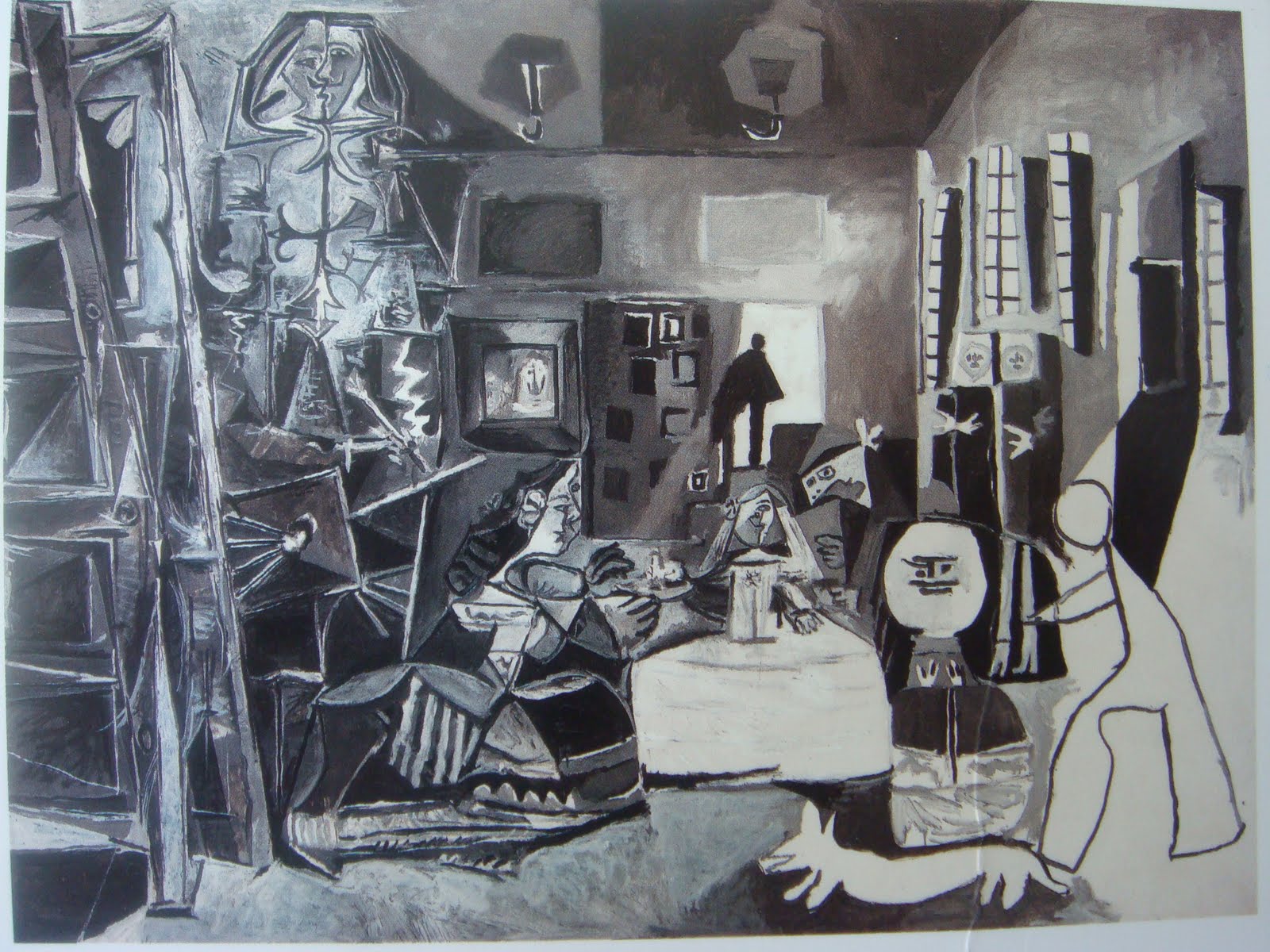
Photos are prohibited in the museum. The museum itself, is very well designed. It takes you through the formative years of Picasso's life, with paintings from his seaside summers, on to his blue period, chronicling his influences and ending with a detailed explanation of Picasso's many and varied interpretations of Las Meninas, Velazquez's most famous painting.

You are glad that they don't allow photos to be taken - it gives you time to immerse yourself in the stupendous imagination of this prolific painter. There was a blind man with a woman on his arm, who was describing each painting to him and reading out the text that accompanied each section of the museum marking a different phase. It was pretty incredible to see the paintings, but hearing them described to a blind man, was something else entirely. Neeto spent more time than I did listening to the couple, so when she writes about it, I will link to her post.

I bought several postcards of his paintings, including one that does a comparison between Velasquez's original painting which Neeto and I would later see in Museo del Prado, and one of Picasso's interpretations. There is also a bullfight postcard that I bought for my dad as an inside joke: he had asked me while we were planning the trip if I would go to a bullfight, and I had answered "maybe". He was quite upset - I had failed his test - "how could you support this form of animal cruelty?". I also had bought a postcard of painting of a woman, from Picasso's blue period. But I have already given it away to the girl who lent me her backpack that I carried to Spain. The name of that painting is "La dona del floc de cabells".

Here are the postcards:


menu "4 Gats". A representation of El Quatre Gats, a cafe Picasso and other intellectuals frequented.

Huit etats du -Taureau-

La primera comunio (Catalan), La premiere communion (Spanish). First Communion, his first major painting.

Ciencia i caritat (Catalan), Science et Charite (French). Science and Charity, another major painting from his early period of training.

Corrida de toros. Course de taureaux (French)

I found this woman and her colorful attire hauntingly beautiful.
Dona amb mantellina "La Salchichona", 1917.
Femme en costume espagnol "La Salchichona" (French)

"Playa", 1896. This was painted when he was less than ten years old, on a summer visit to the seaside.

Interpretation of Las Meninas
Las Meninas. Conjunto (33). Painted in Cannes, 1957.

Side by side comparison of Velazquez's Las Meninas with Picasso's rendering.

Las Meninas (segun Velazquez) N 1. Cannes 17-08-1957

La Familia de Felipe IV "Las Meninas", Diego Rodriguez de Silva y Velazquez. Madrid 1656.

***
The title is a song by Chambao, translating to "Wet paper". I couldn't find anything else to go with the post.. I wanted to find a Barcelona-based singer, I found only pop songs. I thought of Nina Pastori next, and her album name "Joyas Prestadas" may have been better..but I preferred Chambao's song. If you have a recommendation, do let me know!

May 31, 2011

Spain Vignettes: La leyenda del tiempo


May 4, 2011. Granada.

We reached Granada in the morning, after an uncomfortable overnight train journey. It was quite chilly. We eat croissants, donuts and gulp down coffee at the cafe inside the station. My journal tells us the best way to get to the hostel is by bus. I ask the information centre for directions to the bus stand. ‘Derecha’ he says, at the intersection a few blocks from the train station. It was easy enough to find. The bus stop had an electronic information board letting us know when the next bus would arrive and which direction the bus would be traveling in, quite a novel experience, at least for Neeto and me.

At Oasis Backpackers, we were told we would have to wait until noon to check in to our rooms, about two hours away. We had breakfast, and while Attu and Neeto played games on Neeto’s iPhone, I checked my email. Seven minutes to 11, a guy at one of the computers turns around and asks if we are interested in joining his walking tour. Attu and I were tempted to go, but we weren’t sure if we would be ready at such short notice. The guide said he would wait a few minutes for us. Neeto came by, and said we should try to go. We all jumped and tried to get ready. The less said about my appearance that morning, the better.

On to more important things. We started off with a short history lesson. Our tour guide’s name is Aric. He makes us introduce ourselves, tells us that the stereotype of Spain that we have – olive skin and dark eyes, is actually not true. Spaniards have angular faces, with fair hair and light eyes. The Arabs came to Spain and ruled until the 14th century, when Ferdinand and Isabel, though cousins, decided to get married and combine forces. I think they belonged to the Castile and Leon provinces. The combined might let them take on the Arab rulers, and Granada was the last Arab-ruled place to fall. Then Ferdinand and Isabel saw how beautiful and majestic the construction of Alhambra was, and moved in there. Before the Arabs, the Visigoths ruled.

Aric said the Arabs were not a majority, and yet they were able to rule for a long time because they treated their people well, and their habits kept them disease-free. Habits and customs, like common baths, ensured everyone could live with good hygiene while the rest of Europe fell to epidemics like the plague. The common baths were called Hammams. The streets are narrow in Granada, with doorways kept small. Not because the Muslims were short, but to kill intruding armies because short doorways and narrow streets are hard to storm through. The Albayzin, is a world heritage site, and any new construction in this area must look like the old. There are very few power lines that run through this area. It is as if time has stood still.

Anyway, after the Arab rule ended, their new Christian monarchs were not so tolerant and issued a decree that everyone had to surrender their money and convert to Christianity if they liked to keep their heads on their shoulders. So the Jews and Arabs were assimilated into Spanish society. And with the new found Arab-wealth, Ferdinand and Isabel financed a great many expeditions, including those of a certain Christopher Columbus. Aric said the Arabs took upon Christian symbols as their last names (Cruz, Banderas etc), while Jews took upon last names like Flores. He says it is easy to tell who descended from Arabs, from their last names and of course, skin tone.

We go through some parts of Albayzin, including an ancient Hammam, which consists of three sections: a sauna, a water pool to take a bath followed by a massage area so one can get scrubbed down. There are several new Hammams which are modeled just like the ancient ones so you can get the experience, the only difference being that the new ones are unisex.

“We are walking through the Jewish area of old, how can you tell?” asks Aric.
“The Star of David” I say, pointing to the ground, where black stones make a star against a background of white.

The sun has come out by now, and we can tell its going to be a very warm day. We walk to the University of Granada, from where Aric points out the Alhambra nestled in the mountain across. He says the Sierra Nevada has many caves, where gypsies used to live before. Now, hippies live there. Apparently the Arabs brought the art of farming and other inventions to the European world. They brought their engineering skills and built aqua-ducts bringing fresh water from the Sierra Nevada to the city of Granada. He talks about how they invented the number zero.

Hearing that, Philip, from the UK, sitting next to me, turns and asks quietly, “didn’t Indians invent zero?”

“Yes” I whisper back, but don’t correct Aric, who then adds that the Arabs invented the art of surgery.

Upon which, Neeto, Attu and I look at each other, thinking “well that’s not true either”.

What is true is that the Arabs assimilated a lot of knowledge in the regions they conquered and spread their knowledge to Europe.

Aric also talks about the Romani people having split from India around the 15th century and traveled to Europe through Russia and arriving in Spain, while the Gitanos arrived a few centuries earlier, having traveled through the Arab lands, through Morocco and reaching Andalucia.

While we walk to the aqua-duct that we were going to see next, we ask each other, well, do you remember who invented surgery? We knew Aryabhatta was known for astronomy, but we simply couldn’t remember who was responsible for having invented surgical techniques.

“We should be ashamed of ourselves” we sheepishly tell each other.

The answer, as it turns out, is Sushrutha.

As we walk with the group, Sylvie, an Australian, says she was going through a mid-life crisis, and had been traveling for about 8 months. She had a few more to go, and then she would head back home and try to figure out what she would do. Her concern about securing a job and her finances seemed apparent, even as she tried to shrug it off. We later find out she started drinking at lunch and just wouldn’t stop drinking through the day.

Aric, was an engineer from Australia. He tells me he has been in Granada roughly six months, and was planning on staying a few more before he headed to London. He was a musician, a guitarist, now taking lessons in flamenco. He says he has made a few contacts and is hopeful of making it work in London.

I am wistful by this point. Would I ever have the courage to just leave everything and go around the world traveling?

As I later describe to my friends in Australia that I met a lot of Australians at almost every city in Spain, they confirm that “Australians live to travel.”

It’s a cultural thing, I am sure. We are driven by financial security.

In history books, you always hear that Nalanda University, the earliest university, attracted students from across the world. We read of French, Portuguese, Chinese, Japanese and other explorers from different parts of the world visiting India and recording tales of note of their findings.

But have you ever heard of any Indian explorer going off on such a similar endeavour?

The answer: No.

True, the gypsies were the only known Indian-traveler-groups, but they don’t fall into the category we are talking about. Shankaracharya roamed the four corners of, well India. King Ashoka, sent his children to Sri Lanka and the Thailand/Malay regions, to spread his new faith - Buddhism. The Chola dynasty did rule over some parts of the Pacific Rim. There were also some artists sent away by their kings as a gift to their visitors, or captured as slaves, they weren’t travelers of their own will, so they don’t count either.

Growing up, we only read about the achievements of ancient Indians: inventing the number system, inventing the art of surgeries (Sushrutha), ancient precise astronomical calculations (Aryabhatta), ancient political treatise (Chanakya) and others from varied and diverse fields.

Not a single explorer among them.

You think of all the brave souls that set sail despite a pervasive belief that the earth was flat. Ancient Indians knew the earth wasn’t flat, and yet they stayed.

Back to the aqua-duct: we walk down a short steep slope that ends in a stream. There is a tunnel at the mouth of the stream, which is filled with slippery stones, slippery from centuries of having water flow through the tunnel. Stick to the left hand side, its less slippery, says the guide.

The water is very cold, having originated in the eternally snow capped Sierra Nevada. Its completely dark inside, and we feel our way forward as though blind, and taking very small steps so as not to slip. Halfway through the tunnel, I feel my feet getting quite numb, grateful that I have to lift my leg for a few seconds of relief in order to put it ahead of the other foot. As we reach the end of the tunnel, you can see full might of the water falling down from a hole near the ceiling on one of the walls of the tunnel, directly across us. Light streams in from above, near the roof of the tunnel. There are brown, rusty-looking foot holds next to the water, leading up to the light. They look like no one has tried them in years. We come out of the tunnel quite pleased with our little adventure, glad we decided to go on the walking tour.

We were running late for our Alhambra appointment, so decide not to join the group for tapas. On our way back, Aric points out a flamenco bar, and a restaurant for great food, both of which we would return to later that day.

**
Title: I had trouble picking between "Entre dos aguas" by Paco de Lucia, and "La leyenda del tiempo" by Camaron. Both are wonderful, have a listen!

May 25, 2011

Spain Vignettes: Conversación, habitación

May 5, 2011. AVE (Cordoba-Sevilla).

We boarded the train after taking DDLJ style pictures, commemorating the many ‘near misses’ with catching the train throughout the trip. Without a male lead, however. The train stops in Cordoba for just about a minute. Most of the passengers in our compartment were sleeping. It was a few minutes to midnight, after all. Attu wanted the window seat, per usual. Neeto claimed it. I sat across them, next to a girl dressed in black. She had her headphones on, and seemed to be listening to one of the channels provided on the train. A crew member passed by, handing us our headphones. I decided to try using them, for a change. Without unwrapping the wire, I tried pulling on it to let it unwrap itself. It tore into two pieces. Attu burst out laughing, my neighbor tsk-ed, and Attu handed me her headphones. I was more careful this time.

Tomfoolery is always a great ice-breaker, isn’t it? We started chatting. She was traveling from Madrid to Sevilla, to go to the fair. She spoke in very tentative English, but well enough that I could understand what she was trying to say even when she forgot a few words or used the wrong word. She said she never got to practice her English because when she met up with her friends, all from Spain, they would invariably talk only in Spanish. She was going to be an English teacher, “so it’s good that I get to practice with you.” I said I didn’t mind at all.

She asked if we were going to the fair. Of course. She pulled up a pic on her iPhone. Two women dressed in flamenco dresses, with their backs to each other.

“That’s my sister in the red and black-polka dotted flamenco dress, I am going to meet her and her Andalucian boyfriend. His family lives in Sevilla. Do you like my dress better or hers?”

“Wow. Well one of my favorite combinations is red and black, but the plain red with white trimmings looks fabulous” refusing to pick one.

She seemed slightly disappointed that I took the wussy way out by not picking one.
She asked where we were from, while Neeto and Attu kept laughing in a giggle fest that lasted almost the entire, albeit short, journey. Later, I would find out that they were listening to Attu’s iPod, and when it featured Tamil songs, Neeto would mime expressions (not knowing a word of Tamil), or mime dance/Rajni moves. Which was probably a wonderful show, at least from Attu’s mirth.

Because the girl seemed concerned, and I couldn’t get Attu to tell me why they were laughing without her bursting into more peals of laughter, I signed that they were both ‘un poco loco’, that didn’t seem to allay her concern, disconcertingly.

I told her where we were from, where we lived, and she said she probably doesn’t have the courage to travel like we were doing, let alone live elsewhere. I said it really wasn’t a big deal, plus we love to travel.

She asked me the question most locals will ask of their tourists: “Which place did you like the best?”

“I had an unexpectedly great time in Granada, Barcelona was beautiful, but I think if
I were to pick a city to live in, it would be Madrid.”

“You are only saying that” she laughed (I am paraphrasing here), correctly guessing that she would get that reply given that she was from Madrid.

“No, I am a Real Madrid fan, so I will pick Madrid”

She was pleased that I had made the right choice. She obviously loved the city she was born and raised in. She added “Barca, not so good. I don’t like Cristiano, he is too selfish, but I support the team”

I am surprised fans of the club think that of him, and not just his detractors.
She asked if I had been to El Retiro in Madrid. I said we hadn’t had the time. She was nonplussed. “But you have to go there!” It was true then, that all madrilenos spend their weekends at El Retiro.

I asked her about the fair. Feria de Abril, held two weeks after Semana Santa (Holy Week), in Sevilla.

She said the grounds for the fair are huge, and there will be casetas. I had to ask her to spell out ‘caseta’ for me in my journal. A caseta is like a tent within which people have private parties.

“I would invite you to the caseta that I am going to, but I am a guest myself, so I can’t.”
She was sweet to even think it.

She asked if we were going to the fair that night. I asked Neeto and Attu, we figured we could decide once we reached the hostel. She wrote down her name and phone number in my book. Cristina.

“Call me if you are coming tonight, I will introduce you to my sister and her boyfriend too. i won’t be staying long tonight though, I am so very tired.”
I said I would call her if we went to the fair, if not that night, then the next day (to be precise, both were the same day).

The train reached Sevilla, we waved goodbye. We decided against going to the fair that night, we were so very tired too. When we did reach the fair the next day, it was too noisy to try calling. I didn’t get a reply to my text message. We didn’t see Cristina again.

**
Title: Conversación, habitación is a song by La Fuga.

May 17, 2011

Spain Vignettes: Ahi estas tu

April 30, 2010. Madrid.

I thought I would wake up early and pack with enough time to be able to make it to the bus stop about half a mile away and take a bus to the airport bus stop. As the bag was being packed, any desire to carry it for any length of time disappeared. So I called the airport shuttle to pick me up. I was bright and early, the flight was late. So I settled in to read The Trial, by Frederick Forsyth. Now, I have read quite a lot of Forsyth. For the first time, I was noticing Forsyth’s writing style, and not in a good way. The book was written in 1978. So this could mean one of two things a) I have started paying much more attention to writing styles or b) Forsyth’s writing improved with age.

In this book, he treats his characters with contempt, and perhaps his readers too. You are told who is to be admired, who is unremarkable and should be cast aside from your attention, the ‘ugly’ characters have no single redeeming quality. The story however, set in France and Germany during and after the Second World War, is compelling. As any Nazi war story is wont to be. I kept the book aside when Neeto joined me at Newark.

The Continental rep couldn’t help us switch seats so we could be seated together as the flight was full. But we were giving up a window seat for the in-between seat, so the switch was accomplished easily enough. The flying time was only 6.30 hours, and Neeto slept while I tried to. Attu had suggested we check our bags in, and we were glad we listened. After picking the bags up, and some confusion about the airport’s layout we finally made our way to the zone where Attu would be arriving. My biggest surprise, or shock, about the airport, and as I would later find, the entire country? No water fountains anywhere! For someone who gets on a high horse about buying plastic water bottles, I would appreciate it if you didn’t remind me of this lapse.

Attu found us waiting outside the arrivals section at her gate. I hadn’t seen her in four years. Thanks to modern technologies, and Skype, it doesn’t feel like it has been that long. Introductions were made, and we headed towards the metro station. I brought out my little journal. I knew I was going to bring the journal long ago. I wasn’t going to take a laptop, and traveling always makes me want to write, so the journal would have been handy as it was small and could fit into a purse. So I decided against taking tons of printouts, and compiled information on it as well. Flight information, travel from airport/train station to hostels, things to do in each city and corresponding locations, everything I could think of. This effort had taken more time than anticipated, but was completely worth it as we didn’t have to waste that time in Spain trying to figure stuff out.

We got on the pink line, switched to the dark blue at Nuevos Terminos, switched to light blue line at Tribunal. And nearly two hours after we had landed, we emerged out of the Anton Martin station.

It was a cloudy day, with the promise of rain.
The best part? We were in SPAIN!

*****

Title: Ahi estas tu is a song by Chambao, and is used in Spain tourism ads.

May 14, 2011

Spain Vignettes: Poquito a poco entendiendo


May 6, 2011. Sevilla.

I woke up and got ready in the attached bathroom, and woke Attu up. After she came out, we woke Neeto. In the ruckus we were creating, the other three kids got up as well. The girl, who Attu thought was German because she was reading a German book, brushed and left with her bags. The young-looking kid got up and went out. I can’t remember if he brushed his teeth, but certainly hope he did. The third chap called Sebastian was from Chile. He looked remarkably like a young Raul. Yes, the only Raul that matters, to el madridismo.

We hadn’t eaten in more than 12 hours, and our dinner the previous night was barely a snack. I was mighty hungry and had to eat something, so I went to the other hostel building where the kitchen was. Attu decided to stay back and wait for Neeto. In the kitchen, there were four people. Sebastian and another guy called Sam, from Michigan. He had just finished school and was traveling before he resumed his job search. He had already spent 3 weeks in France. Like we all suspect, the French do not like to admit they know English until they have seen you try to speak in French. He said he had a great time in France, and his girlfriend had spent time in Paris with him. Tina was from Australia and asked where Sebastian was from. He said Chile (pronounced: chee-lay). She didn’t understand, and then when he repeated himself, she automatically corrected him “Oh, Chili!” she said. Sebastian shook his head and laughed “No one understands me when I say Chile”. Tina then realized her mistake “D’uh of course you would be pronouncing the place right, you are from there!”
The conversation turned to creepies and crawlies for some reason. Tina spoke about leeches, and how you had to get them off you with salt. I told them about how as a kid we were careful about leeches, and that the only way we thought it could be removed from your skin was by cutting it in half. I then spoke about the stink bug infestation. Sam mentioned how New York was teeming with bed bugs. Sebastian didn’t know what a bed bug was.

Sam and Sebastian had already spent the previous evening together, and were planning on walking around the city. Tina was traveling alone. She asked if she could join them. By then Neeto and Attu had arrived for breakfast. Sam asked if we wanted to join them too. Of course we did.

As it turned out, Sam had been on a walking tour the previous day. So we elected him our tour guide. He actually remembered quite a bit from his tour and was an excellent guide. We started at the house of the American painter who made the association of bull-fighting with Spain famous. He took us to a statue of Don Juan, the famous libertine, who apparently every region in Spain stakes claim to. There was also a ‘Don Juan’ terrace that he pointed to as a prominent theater, opera and movie reference for romantic scenes.

He showed us a cross on the side of a building. Two crosses actually, which were the sole surviving crosses from a devastating earthquake in the 17th century. He said while southern Spain was hailed as a melting pot of Jewish, Christian and Muslim populations, they had always lived in different parts of the city and didn’t mix. The Jewish quarter had narrow streets, designed to keep the buildings cool. There was one particular street, with five names. I noticed a shop with flamenco shawls at decent prices, which we would go back to later in the day. One of the names for the street was Calle de la muerte (death). The legend is that during the Christian annihilation of the Jews, there was a Jewish woman Susona, who told a Christian man that she loved, of her dad’s plans for armed response to the Christian murder of about 4000 Jews a few days prior. The man, a soldier, promptly informed his superiors, who were prepared when the Jewish response came. Susona’s entire family and roughly 2500 others perished, her love was not returned, and so she cut her head after asking that her skull be hung forever as a reminder to the people. The street was renamed Calle Susona and her skull hung there for about a hundred years. After which the city officials decided it was too gruesome to have the skull around and replaced it with a plaque instead.

We then walked to the Plaza Espana, where we saw women in flamenco dresses, and the cutest kid in a bright orange flamenco dress, which was arranged in such a fashion around her crib that it looked like she was swimming in frills. She took a few tentative steps, and as I lifted her up in my arms. Spanish parents, particularly in Andalucia seem to be fairly relaxed. I am not sure if I would have tried lifting a stranger’s kid in the US, but like another friend who visited these parts had said, it reminds you so much of home that you would dare to do so.

We found a menu del dia place for lunch.

Sam described how he met a Canadian guy in Madrid, who had remarked that he had met an American douche-bag earlier. Sam explained. Apparently, the Canadian had asked where the other American was from, and he said “Tennessee. Where are you from?”
The Canadian replied “Canada”.
D-bag: “Oh. I am sorry. Which part?”
“Quebec, a French-Canadian region”
“French-Canada? I am doubly sorry.”

We all wondered why such a small minded person would even bother try seeing the world. And heck, how can a guy that lives in Tennessee look down upon others?
Sam had been an exchange student in Chile, near Santiago, where Sebastian is from.
While we ate, I am not sure quite how this happened, but the conversation turned to how many languages were there in India. I said “Hmm more than 1400”. To Sebastian’s shocked face Neeto added “Well there are 18 official languages, but the rest includes dialects and other languages not in official use”. The concept seemed entirely alien to him.

“But why would you have that many languages?”
“Well we have a rich history, each people had their own language”

“But you are one country. Doesn’t it make things difficult, having that many languages?”
“Yes, but we are used to having a lot of languages”

“Why are you one country then?”
“Thanks to the British actually, they helped unite the many scattered kingdoms into the cause of the freedom struggle and unify the country under one identity”

“But if you have so many differences, do you have one identity, really?”
“We have other things to unify us besides language. The most recent example is when we won the Cricket world cup and that brought the country together in support of the team”

“Why can’t you just pick one language and do away with the others?”
We are completely shocked now, our turn at having an alien concept presented to us.
“So, firstly, our languages have existed for thousands of years and each major language is spoken by millions of people, you can’t really expect people to throw away their history because language is so much a part of you. Secondly, after Independence was won, our leaders promised that each language and religion will be respected and that’s why each region agreed to be part of the union. If not, we might have been many different little Indias today. That’s the idea of India. Pakistan, founded at the same time was based on a different idea, that of a Muslim state”.

I tried to remind him that even in Spain, for instance, four languages are spoken, Castilian, Catalan, Basque and another that I can never remember the name of (Galician and one more, Aranese). And there has historically been conflict because Franco tried to impose one language on the entire country. Sam then tried explaining to him that the Basque separatist movement was quite violent and ongoing. Actually, a few months ago, the ETA had agreed to lay down arms, but that was beside the point so I didn’t bring it up.

“What about religion?”
“Well, we don’t have an official religion, all the off-shoots of Hinduism are practised, and obviously the other major religions of the world”. We listed all of them. “At this table, one is a Sikh, the other two are Hindus..but we are not both the same Hindus, we practice our faith differently and celebrate different festivals”
“Like there are Episcopal, Presbyterian and other types of Christianity” Tina added.
Sebastian had some more questions about the movie industry, and yes, most of the major languages have their own movie industry as well.

Tina then talked about how her stomach had shrunk because of doing weed constantly for about 3 years, and Sebastian had some questions for her too. He explained, “I decided not to do weed anymore. I suffer from complete memory lapses when I do weed. I decided about 5 days ago”. To which I asked, “But what if you don’t remember that you decided not to do weed?” Cue laughter.

We dug into her spinach croquettas and caramel dessert because she couldn’t eat anymore. The food was decent, especially the arroz con mariscos dish which was placed in front of Attu and we had to remind her once again that if she didn’t eat quickly there wouldn’t be any food left for her to eat. When I tried to make sure Tina’s spinach croquettas didn’t have any beef, Sebastian asked about beef. Neeto said Muslims and Christians ate beef, as you would expect. He then asked what happened to the cow’s meat when they died of natural causes. Attu said they were cremated. I actually didn’t know what happened; I thought there was a black market for the meat or something of that sort, so I learnt something new as well.

After we had answered all his questions, he turned to Sam and said “I had never spoken to an Indian about India before today…. You learn a lot when you travel”.

Sam added “Especially when you travel alone”.

*****

Title: Pokito a poko is a song by Chambao. Its one of my current favorites, and I was mighty pleased when the commie caseta in the Fiera played this song.

May 10, 2011

Spain Vignettes: Soy gitano

Note: Spain related posts will most likely not be in chronological order. If and when I write more, I will try to link them in the order that it should be read. Although my two friends and I didn't really have any ground rules for the trip, we were asked to do everything together by our parents so they could feel better about our safety. And so we did stuff everyone was interested in doing and ate what everyone felt comfortable eating. While we pretty much did the same things, forgive me if my writing seems to be only from my perspective. When the other two post their travelogues, I will link to their posts. I had a fantastic time in Spain.


May 4, 2011. Granada.

Aric, the walking tour guide pointed us to La Buleria, if we wanted to listen to flamenco music. The bar was owned by a flamenco legend’s family (Paco de Lucia’s nephew’s family, but I could be wrong), and although there were no scheduled performances, all flamenco artists congregated there after their performances elsewhere, and just jammed. Traditionally, this is how flamenco evolved, with people congregating in café cantentes or tablaos, not with shows or set pieces as it is showcased now. He suggested we go around 1 AM. We got there around 12, a bit too early, there was hardly anyone. The bar itself stocked only hard liquor, and there was a cave like place inside, where about 15 chairs were set in a circle with the backs to the wall. The walls were white, with a very uneven surface, and there were pictures of flamenco artists on the wall. The sound system was playing Camarón de la Isla. I asked if they could put on Orobroy by Dorantes, a song I hadn’t heard since I got to Spain, and one that I missed. The dark haired guy at the bar was dressed entirely in black and said he didn’t have the song. All communication was in Spanish and given my limited grasp of the language, involved a lot of sign language as well. The drinks were a bit too strong for our liking. The martinis that Neeto and Attu ordered were composed largely of vermouth, and a little bit of gin that had to be asked for. My vodka was unwatered down as well, as we realized much later than I could have asked for lime with it.

There was a couple that was already sitting when we arrived. A man in a blue shirt, with hair tied into a pony tail, and a beautiful woman with a camera in hand. One of the men at the bar brought in his guitar, and played us a song strumming along with the guitar and singing in a deep throated voice. After he was done Neeto asked if we could record a song with our cameras, and were told we could, only for a bit. I went to get Neeto a beer.

Una cerveza, I asked the man who had just played for us. He got me the beer, while I asked how much it was and paid the dos euros, he pointed to my skin color and asked if I was from India. I smiled and said Si. He said he was Gitano, the gypsies who originated from India and traveled through the Arab lands to reach Europe. He was short, and older than the other man at the bar. I tried telling him he played really well. I added I was learning flamenco dancing, sevillanas to be precise, this seemed to please him. We couldn’t continue the conversation anymore with our limited mode of communication, so I went back to my seat. After a while, a few more people had ventured in, and he came back to play some more. The music system was switched off, so I leaned over to ask him if it was indeed Camarón de la isla that had been playing all this while. He confirmed it was, and the man in the pony tail took the square box that was offered to him, to accompany the guitar with drum beats. His female friend switched on the camera to record the both of them and all through the night, looked at him with such an expression of love and pride on her face, I won’t even try to describe it. The older man started singing Camaron, and everyone listened, raptured. The pony tailed man sang the next song, and his smooth voice was incredible as well, and such a contrast to the rough edged voice of the older man. Another older man at the door, saw me keeping the beat with my hands, and pointed to the middle of the circle and said I had to dance. I tried refusing, because I really am terrible at flamenco dancing being a mere beginner. My protests were brushed away, so I reminded the guitarist that I only knew sevillanas, preferably the first copla, so he asked the woman to dance a sevillana with me. The sevillana began and ended much before I realized it, while the onlookers clapped the end of it, and Neeto and Attu seemed to think I had done well. The others from the walking tour who had joined by then were also glad that we would seem less touristy now that someone amongst the group had danced with the gitanos. We had more songs from the pony-tailed man and the guitarist, and I recognized some other Camarón songs as well, not knowing the names of the songs but having heard enough Camarón in the recent past to know when some of his songs were played.

The older guitarist then said mi familia (his family) had arrived at the bar, which also comprised of a young girl about 8 years old, but no one cared that she was in a bar, and quite awake at 1 AM. There were a lot more people by now, some smoking hookah near the entrance, some dancing in front of the bar and others in the cave-like section, like us, listening to the music being played. The dance was a bit more fluent than the flamenco I have learnt and seen so far, presumably because the gypsies dance differently than what is taught in Spanish flamenco schools, with the hand and leg movements being less precise and hip movement not frowned upon.

There were some songs that were made up by the ponytailed man, at least it seemed that way because he seemed to be either substituting lyrics of a song or making them up entirely as he went along, and his audience was in splits. Never have I wished as much as I did that day, that I knew Spanish. The women in the guitarist’s family danced in the circle, all of them having a great time. The little girl bullied me into dancing once more, and I tried making a deal with her that if I did she would dance with me. She signed that she would dance after I did, but completely reneged on our deal!

After some more music, we left the place around 2 AM, with the Australians we had met on the walking tour. As I stepped out of the bar after having said bye to all the gitanos, the older man (not the guitarist) who had initially pointed me to dance gave me a double thumbs up.

Granada was indeed a revelation, and we were really glad we had come. You may visit a place and enjoy its architectural beauty and history, but mixing with the people always makes for the best experiences and memories.

******

Title: Soy gitano is a song by Camaron de la Isla. There are other songs of his referenced in this post as well. Enjoy!

February 24, 2011

Travelogue: Andaman & Nicobar Islands

I usually stick to posting short stories on this blog. But I heard a story on the radio today about the threat to corals, and I was reminded of my trip to the islands. My trip was more than ten years ago, and I do not have my photos handy for reference, so forgive the hazy details on this trip to memory lane.

It was before 9/11, and the cockpit doors were not kept resolutely shut on the flight. My dad had heard somewhere that kids would be allowed to enter the cockpit and talk to the pilots if they ventured that far, so my brother and I were forced to try our luck. The view from the cockpit was everything you would imagine, with clouds dotting the sky, and the outline of islands appearing on the horizon. One of the pilots pointed to the Sentinel islands, the first group of islands that appear in the sea on the way to the Andamans, and said he would drop us off there. When I didn't understand the significance, he explained that the Sentinelese did not have any contact with the outside world and that they were a cannibalistic tribe. I suppose the shock on our faces was worth it.

The pilots offered us tips: to use plenty of mosquito repellent, and to check out the Sound & Light Show at Cellular Jail in Port Blair. The air strip used for landing in Port Blair is extremely short, so only skilled Air India pilots are allowed to land here. I heard that there was a new strip being built so this may have changed now. We were staying a week, and I am fairly certain there was some trouble with our tickets, as can be expected with Air India, but we didn't let that spoil our visit. I think the first thing I noticed was that the blur of activity was like in any other part of the country. The people looked the same as well, explained away by the fact that us 'mainlanders' had overrun the place and pushed the natives out. One of the museums we visited had the history of the Jarawa tribes amongst others, which according to Survivor International, is in danger of being wiped out after increasing contact with the outside world. These tribes are considered to have been among the successful migrants out of Africa and it would indeed be a shame if a curious and avaricious outside world destroys the tribal ecosystem.

If you ever visit Port Blair, make sure to find the schedule for the Sound & Light Show, and visit it. The Cellular Jail is an imposing structure, with seven wings and three floors of cells. Three of the wings survive to this day, and the show highlights the tortures these walls have seen. We understand our freedom was largely a non violent movement, but that there was always inhuman treatment meted out by the other side. Just how inhuman the conditions and punishments were and how much suffering our independence seekers endured, you will find out during the show. The prisoners from the 1857 struggle were sent here, and Vir Savarkar was one of the more famous prisoners. While walking/traveling around the cliffs of the island, you will see round hole outlets. These were tunnels that sent bodies directly to the sea after they had been hung.

I always pictured these cells while reading JKR-Harry Potter's Azkaban references, more real to me than the presumed inspiration, Alcatraz.

The differences with the 'mainland' start with dawn. The sun rises at 4.30 AM and it is completely dark by 5.30 PM. We took quite a few day trips to various gorgeous islands nearby, and there was plenty of swimming.

The Ross Island is a big draw, for the dilapidated ruins that conjure up images of British colonial life, from their capital in the islands. If I remember right, outside of the church we got to see deer that were quite friendly and posed for pictures. Today, the island is uninhabited, save for the daily visits of curious tourists. And yet, you see water bottles and other plastic paraphernalia strewn about where the land and the sea meet. There are bunkers reminiscent of the march of the Japanese during the Second World War, when they had reached as far as the Andaman & Nicobar Islands, and built bunkers as they watched for enemies. The Allies did retake the island, but didn't stay.

I remember going to Viper Island, Jolly Buoy and Barren Islands. The last one, you cannot get on, but only go around. Its amazing to swim on the picturesque beaches, especially with all manner of fish unhurriedly going past you. My dad actually saw a gorgeous fish, a kind we had never seen before, and while one of the uncles took a video, he tried catching it with a towel, but failed. Just as well. When we returned to Port Blair that day, we went to an aquarium where we found out the yellow-with-brown-stripes multiple-finned fish was called Lion-fish, and that it was poisonous and could lead to fatal injuries. I think Jolly Buoy's the one around which you can take glass-floor boats that show you the coral reef in all its glory. I am not sure why the island got its name, but it may have something to do with the tide's effect on the coastline - think of the beach in Dead Man's Chest from the Pirates trilogy.

Havelock island has some of the best beaches in Asia, as per Time. We went snorkeling on the beach, and looked at corals up-close. The boats leave you in the morning and come back to fetch you later in the day. The beaches on Havelock are the best for swimming, and I remember trying but giving up snorkeling here. I tried standing on the sea floor, and felt a nip on my leg, assuming it was a clam I ignored it and went back to the beach. After a good many hours spent at the island, while on our way back to Port Blair, a Bengali family that had spent the day on a rock overlooking the beach informed us that they saw a croc sunbathing in the distance. I was completely flabbergasted at the nonchalant way in which they informed us after the fact. Now, having grown up listening to tales of careless arms, children and grown men being eaten by ever-watchful crocodiles, especially in rivers, I am still amazed at their uncaring comment.

Or maybe I am just scared of crocodiles.

The coral reef system extends from the Andaman & Nicobar islands, all the way to Australia, and is in danger of being wiped out. By raising temperatures, unsustainable harvesting and improper care. Unless a 'herculean' effort is made, nearly all the coral reefs will be in danger in just a few decades (from today's radio program). Man is the only being to change his environment to suit him, we can only hope that the rest of the planet survive the changes, or ultimately we won't, either. But the first step should probably be everyone acknowledging that we have a grave problem on our hands, and obtaining consensus on just that is in itself a monumental challenge, given current attitudes in some parts of the world.

Dangers to the corals aside, a trip to the islands is well worth the visit, and the tan!

May 10, 2006

Journal


This trip had been in the planning stage for oh-so-long. And finally we were on our way. Diminished in number, and in stature. The AC Tempo traveller became a non AC one due to sudden unavailability of the one we had booked. There were supposed to be twelve of us, and that became nine. But dodo sure wasnt complaining, esp since she bagged the last seat and was probably the only one who slept comfortably.

As we settled into our rooms, srinath entered ours and sneezed. A huge ball of mucus fell down on the bed. Wait a minute, it was lavender in color. Sure wasnt mucus. But definitely icky. Su, the proud owner of the slime, hung on to it the rest of the trip. Throwing it at people. But of course, the cover of the slime-thingy said 'Suitable for: Five Years and above.' He qualified.

After lunch, our guide/ owner of the guest house was briefing us about the rafting. Do not wear rings. Wear sports shoes. Pratima kept insisting that the windows of the guest house should be kept locked at night, to avoid snakes. So someone asked the guide if there were any snakes. 'Sure' he pointed in the direction of the fields behind the guest house, 'you will find plenty of King Cobras there.' We were truly in the midst of the jungle. No network (mobile). No landline connection.

'Elephants?'

'Once in a while.' He came back to the rafting trip. I ventured, 'Crocodiles?' in jest.

'A few.'

Shocked stares. 'You mean they allow us to raft in crocodile infected waters?'

'No m'am, they aren't found in the place where the rafting takes place.'

Big consolation.

We left for the Jungle Lodges, from where a jeep would take the nine of us to the rafting starting point. It was an open air jeep. An unexpected bonus. We stood most of the one hour ride, quite forgetting the crocodiles part. Finally, we reached the starting point.

John, with a British accent, took over, made us form groups, told us that we were to travel in 6 rafts. There were 40 of us, all set to do our bit of adventure sports. Jo( separated from Su), Shashi, Nitesh, Raful and me were in one raft, headed by John and another chap, white male caucasian, was with us. His name was Manu. We will come back to him in a mo. Dodo, Su, Parts and Srinath were in Bobo's raft, along with a couple. Bobo was from Sweden. And was just three days old in River Kali.

Life jacket, helmet and the oar adorned, we set off. Not so fast. The safety instructions. Forward paddle, Backward paddle, Hold on, Get down and Hold on, Over right, Over left. As if that weren't enough, we were told how to swim if we were approaching a rock, how to pull someone from the water onto the raft, what to do if a raft overturns, et al. I was having visions of the raft overturning and me forgetting all the instructions. Jo apparently, was thinking the same thing of herself.

Then came the customary dips in the water. It was really cold, and the river bed was not within reach of our legs. John took Manu's glares before his dip, and commented on how expensive looking they were. Not a moment too soon, for one eye piece popped out in his hand as he said it. Manu had bought it at a two dollar store. No wonder!

Su was more worried about his pants slipping off, than anything else while taking his dip. Thank god the procedure to pull someone back into the boat was to pull the lifejacket, not the hands, else he would have been hanging on to his pants, instead of the savior's hands.

John went around telling each raft their position, and we were the last, and Bobo's just before us. The first rapid was upon us before we knew it. John told us it was the biggest rapid in the entire rafting section. We were feeling quite brave after that, till he added that there were difficult ones up ahead.

Forward paddle, backward paddle.. Get down and hold on! was all we heard. In the lull of conversation, Jo and I tried making conversation with Manu. He was sooooooooo cute!!! When he got a leaf stuck near his eye, both of us pointed it out to him. Like he couldnt see it! ;)

Bobo, as I mentioned, was very new, and almost lost his way a couple of times, besides getting stuck on a rock, and teaching his rafters a Swedish war chant. He asked the Dodo, Parts, Srinath and Su if they were couples. They shook their heads in denial, and quite forgot what they were. Finally one of them said ' Just Friends', to Bobo's disbelieving grin.

I asked Manu, 'how did you get that name?' you know, him being a caucasian and all. 'Long story' he said, too bad we didnt get to hear it :(

John is married to an Indian, and stays in Bangalore, and holds a PIO card. The only difference between him and us, he said, was the skin colour, and swimming abilities - his being better, of course !

Too soon, the rafting trip was done. One and a half hours went by in a flash. And we were soaking wet. Parts whispered to Jo about Su's pants getting loose in the water. And made a claim to the colour of his chaddis.. Su was within hearing distance, and proudly pulled down his pants to give them both a closer look. Not all the way down, thankfully. Black Jockey, if you were wondering (not that I looked)!

John and Manu hitched a ride in our jeep. No complaints from me n jo. :) All of us talked about Bangalore's traffic, and Manu was complaining about how he takes one minute to get to work, in Dandeli! grrrrrrrr.

On our way back to the guesthouse, Jo's singaporean hat was used as a lampshade, pirate cap, and also as a face-cover for those who wanted to sleep. We had a campfire outside the guesthouse, and each one was made to dance, except for Raful. Su started off with a Nagin dance, Dodo did a lovely imitation of 'Kya bolti tu' and Pratima rocked with her hop-skip and jump to the tune of 'Mummy...' around Su !

We were all determined to stay awake, so a few ghost stories/ encounters made the rounds. Which left Jo quite scared of walking back to the guest house alone ;)

There were two bedrooms and a huge hall in the guest house. Jo n Prat persuaded the guys to sleep in the hall( on the mattresses, silly!) and they went to the room, quite pleased with themselves on having bagged it. Till they saw the undies displayed on the window railings. In all shapes, sizes and colours. They tried speculating on the owner's, apparently. We shall let it rest right there!

Srinath woke up in the middle of the night, unable to sleep coz of the pain in his rowing arm. He went to Jo's room to ask for a tablet, and was quite scandalised on seeing them both sleeping, ah well, quite next to each other; and almost retreated from the room. Then he realised that both Jo n Prat had been given just one pillow between them, and went back to the room to get a painkiller from Jo.

After many flip flops on the plan for Sunday, it was finally decided that we go to Yana, along with stopovers at a waterfall and a religious place. The waterfall was quite a disappointment, as we couldnt get into the water and we could only take pics of it from a cliff. The religious place we went to was much the same, with shivalingas that apparently are formed all by themselves, which looked quite improbable. Su went to a guru and performed a pooja, probably keeping his progeny in mind, and came back with the story that a king was asked to build all these shivalingas so he could have a kid.

We set off for Yana, thinking that the most fun apart from the rafting trip had actually been the travelling, in part due to the scorching sun. Lunch and icecreams at Sirasi, with Su purpotedly trying to kill Jo by giving her one that was well past its expiry date - the icecream, i mean. But we know otherwise! :-P

We had to trek 3 kms to reach Yana, all of it through the jungle, with Srinath and Shashi prodding us on, sometimes with sticks, saying that we had to walk faster as we had to leave the place before sunset. With Su and Rahul making mating calls (probably to each other) hoping for a peek at wildlife, and a gal(who shall not be named here) wanting to take a leak, we somehow made the three kms, and then from just behind a rock, when we were quite tired of all the walking, pops out the mountain. Yana. So beautiful, definitely worth the while. (if thats an expression)


There was a temple set in the mountain, and the poojary told us that many people had tried researching about the mountain, as to how it came about (looking as it does) and no one had a satisfactory answer. According to lore, Shiva kills the demon brothers( i forget their names) and Shiva and Parvati and their followers, took up the mountain forms. There are 63 such rock/ mountain formations in Yana. During the british rule, many uttar kannada followers would make a journey to the temple. When asked by the britishers, they would say 'naavu yaana ge hogthaidhiri'(obviously not d exact words - meaning 'we are on a yatra') and the britishers thought that yaana was the name of the place and named it on the map as such. Thats how the name came to be.

The poojary also showed us the outline of a watery shivalinga that is formed by a steady flow of water, you can actually make out the snake, the moon and the ganges, all in that watery outline. The water flow is constant, that is it never increases at the time of flood or decreases during drought. :) There is a pathway around these rocks which actually is a pradakshina around the temple, which took us through a series of cave like rock formations.

The only problem about the place was its, well, basic amenities with regards to the loos. It was uh well, quite inaccessible by foot, even with raful trying to clear a path, and looked quite disused sitting about ten feet higher than ground level. We shall not reveal how the problem was solved :-P

Then started the trudge back to the tempo traveller. And the exhausting journey back. Dinner at shimoga. Oh I left out the wonderful music collection we had. Himesh reshammaiya and no one else the whole of the first day. CD courtesy: Su. rather, su's bro. Jaggu uncle (driver) had a vcd, of shaadi se pehle. We watched probably 40 mins of it. Not worth a watch. As for the music, we would like never to hear himesh reshammaiya again ;) Thankfully, there were a few songs of Rang De Basanti too. Raful had a collection of old hindi songs and their originals in english! Quite disappointing to know that most of the songs we love, are all lifted tunes. :(

We reached Bangalore! at around 4.30 in the morning, and delivered right outside our homes. Lovely trip, and i hope prat will upload all the snaps before the year ends!